Costume Guide
Ziggy Stardust · 1972 Glam Rock Era · Lightning Bolt Makeup
The lightning bolt. The red spiky wig. The jumpsuit that rewrote what rock stardom was allowed to look like — assembled in five pieces.
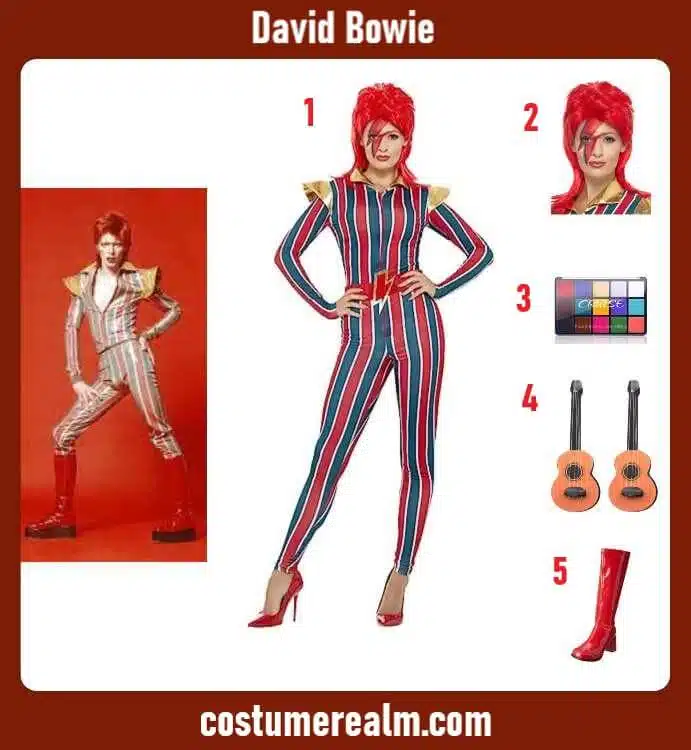
Quick Answer: The David Bowie Ziggy Stardust costume is five pieces: a striped or metallic jumpsuit (men’s and women’s versions both linked), the red spiky Ziggy wig, a 15-colour face paint palette for the lightning bolt, an inflatable guitar prop, and red knee-high boots. The lightning bolt face paint is the single most important element — without it the costume reads as a generic glam rock look rather than specifically Bowie. Both versions of the jumpsuit link to the same item listing; choose whichever fits your body better.
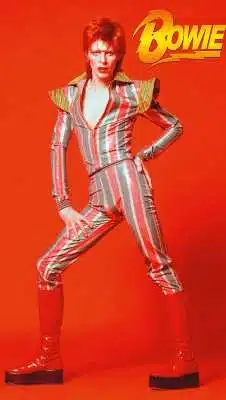
David Bowie’s Ziggy Stardust alter ego — introduced on the 1972 album The Rise and Fall of Ziggy Stardust and the Spiders from Mars — remains one of rock music’s most defining visual moments. The lightning bolt face paint, the spiky red wig, the multicoloured striped jumpsuit: each element was deliberate, theatrical, and constructed to be impossible to ignore. It is a costume that sits in a category of its own — immediately recognisable to people who have never listened to a Bowie album and utterly beloved by those who have. The five-piece build takes under twenty minutes to put together.
This is one of the few Halloween costumes where the performance is as important as the physical pieces. Bowie as Ziggy was theatrical, mercurial, and magnetic — the costume rewards commitment. The more dramatic the makeup application and the more you move like you are performing, the better the whole thing reads. The inflatable guitar is not an optional detail; it is what turns a well-dressed person in a jumpsuit into someone who is clearly doing a Bowie costume. The shopping list below covers both the men’s and women’s jumpsuit options — Bowie’s androgynous aesthetic makes both equally valid.
Affiliate links — we may earn a small commission at no extra cost to you.
The Lightning Bolt Is the Costume’s Core
Start from the forehead, cut diagonally across the eye, and extend down the cheekbone in a sharp angular line — not a smooth curve. Red as the base colour, outlined in blue or gold. The bolt covers one eye only; the other side of the face stays completely clear. Practice the shape on the back of your hand before applying it to your face. The angles are sharper and more geometric than most people expect the first time they draw it.
Wig On Before Makeup
Put the red spiky wig on before applying the face paint so you can calibrate the lightning bolt position relative to your hairline. The bolt starts at the forehead and the wig’s hairline affects where that forehead begins. Do not brush out the wig — the aggressively spiky texture is the entire point. Ziggy’s hair was a statement, not an accident, and a smoothed-out wig loses that energy immediately.
Do Not Size Up the Jumpsuit
Bowie’s Ziggy costumes were fitted and body-conscious by design — the theatrical silhouette depends on it. A jumpsuit that is too loose reads as a generic fancy dress item rather than a specific character. If you are between sizes, take the smaller option. The collar should sit open at the chest. Both the men’s and women’s versions are linked at item 1 — choose whichever fits your body shape better rather than defaulting to one by gender.
The Boots Add Stage Presence
Red knee-high boots elevate the whole silhouette — literally and visually. The height and colour extend the jumpsuit’s theatrical energy down to the floor. If knee-high boots are not comfortable for a full evening, red ankle boots work as a fallback. The colour is the essential element; the exact height is secondary. Avoid black or neutral footwear — it breaks the all-in visual commitment that makes the Ziggy look work.
The Guitar Is Not Optional
The inflatable guitar is what separates a well-assembled person in a jumpsuit from someone who is clearly doing a Bowie costume. Carry it in one hand for walking around, hold it properly for photographs, sling it over your back when you need both hands. A real guitar is too unwieldy for a party and gets in everyone’s way. The inflatable version is lightweight, photographs well, and is completely in character — Bowie was a guitarist, not just a singer.
Commit to the Performance
The physical costume is one component. The other half is the attitude — theatrical, mercurial, magnetic. Pose dramatically. Move like you are performing. Make eye contact. Bowie as Ziggy was a character that inhabited stages, not rooms, and the costume reads better with five minutes of committed character work than it does standing still against a wall. Even a brief dramatic pose when a Bowie track comes on is enough to make the whole thing land.
Duo Costume
Two of rock’s greatest British showmen — both known for theatrical stage personas, commanding live performances, and a complete refusal to be conventional. Bowie’s multicoloured Ziggy suit and lightning bolt versus Freddie’s white tank and moustache are immediately visually contrasted. The duo photographed brilliantly together in real life and works just as powerfully as a Halloween pairing.
Duo Costume
Two artists who made maximalist self-expression their entire aesthetic — Bowie’s Ziggy lightning bolt and jumpsuit alongside Cyndi’s layered neon accessories and wild hair is a visual conversation about what 80s pop was willing to look like. Both costumes reward commitment, both look better the more theatrical you go, and neither requires the other to be recognisable.
Group Costume
Bowie alongside Freddie Mercury and Michael Jackson gives you three eras and three completely different visual aesthetics in one group — glam rock, arena rock, and pop spectacle — all at the peak of their respective decades. Each look is immediately recognisable and there is zero visual overlap between any two costumes in the group.
Group Costume
Bowie alongside Cyndi Lauper and Michael Jackson covers the full visual spectrum of the decade’s music scene — glam rock to pop to dance. Cyndi’s colourful layered look shares Bowie’s commitment to theatrical self-expression, and together the three costumes span everything the 1980s was willing to be visually.
Ziggy Stardust was David Bowie’s most iconic alter ego, introduced in 1972 on the album The Rise and Fall of Ziggy Stardust and the Spiders from Mars. The costume is a multicoloured striped or metallic jumpsuit, a wild red spiky wig, dramatic lightning bolt face paint across one eye, red knee-high boots, and a guitar. It is one of rock music’s most recognisable and most imitated looks — immediately identifiable even to people who have never listened to a Bowie album.
The lightning bolt starts at the forehead, cuts diagonally across the eyelid, and extends down the cheekbone in a sharp angular shape — not a smooth curve. Red is the base colour, outlined in blue or gold. The bolt covers one eye only; the other side of the face stays clear. Put the red wig on first so you can calibrate the bolt’s position relative to your hairline, then practice the shape once on the back of your hand before applying it to your face. The angles are sharper and more geometric than most people expect.
One of the best available. Ziggy Stardust is theatrical, colourful, and immediately recognisable — even people who cannot name a Bowie song will place the lightning bolt and red wig. It also rewards commitment in a way that most costumes do not: the more dramatically you apply the makeup and the more you inhabit the character’s stage presence, the better the whole thing lands. Five pieces, twenty minutes to assemble, and a costume that photographs brilliantly from every angle.
Absolutely — a women’s specific Ziggy Stardust jumpsuit is linked at item 1 in the shopping guide above. Bowie’s androgynous aesthetic makes this costume work for any gender; the character was always about theatricality and self-expression rather than conventional gender presentation. Both jumpsuit versions link through to the same listing — choose whichever fits your body shape better.
This guide covers the Ziggy Stardust era (1972–1973) — Bowie’s most visually iconic period, defined by the album The Rise and Fall of Ziggy Stardust and the Spiders from Mars. The lightning bolt makeup, red wig, and theatrical jumpsuits from this era became his most recognisable costume identity. Bowie had other distinctive looks across his career, but Ziggy is the one that functions as a Halloween costume because it is visually complete and instantly legible.
An inflatable guitar is the ideal prop — it reads clearly as a musician costume, is easy to carry all night, and photographs well. A real guitar is too unwieldy for a Halloween party and gets in the way constantly. The inflatable version is lightweight and completely in character: Bowie was a guitarist, not just a frontman, and the guitar is what separates a well-dressed person in a jumpsuit from someone who is definitively doing a Bowie costume.