Halloween Costume Guide
Obsession, surgical precision, and a pair of hands that do not belong to anyone living.
Dr. Gogol transplants the hands of an executed murderer onto a concert pianist’s arms and then tells the pianist they belong to him. He is a surgeon, an obsessive, and the most unsettling character in a film full of them. Peter Lorre plays Gogol in his first American film role, directed by Karl Freund for MGM in 1935. The film is an adaptation of the 1920 novel “Les Mains d’Orlac” by Maurice Renard (Wikipedia). Recognition at a general Halloween party will be low. This is a costume for people who know the film or want to explain it.
Affiliate links. We may earn a small commission at no extra cost to you.
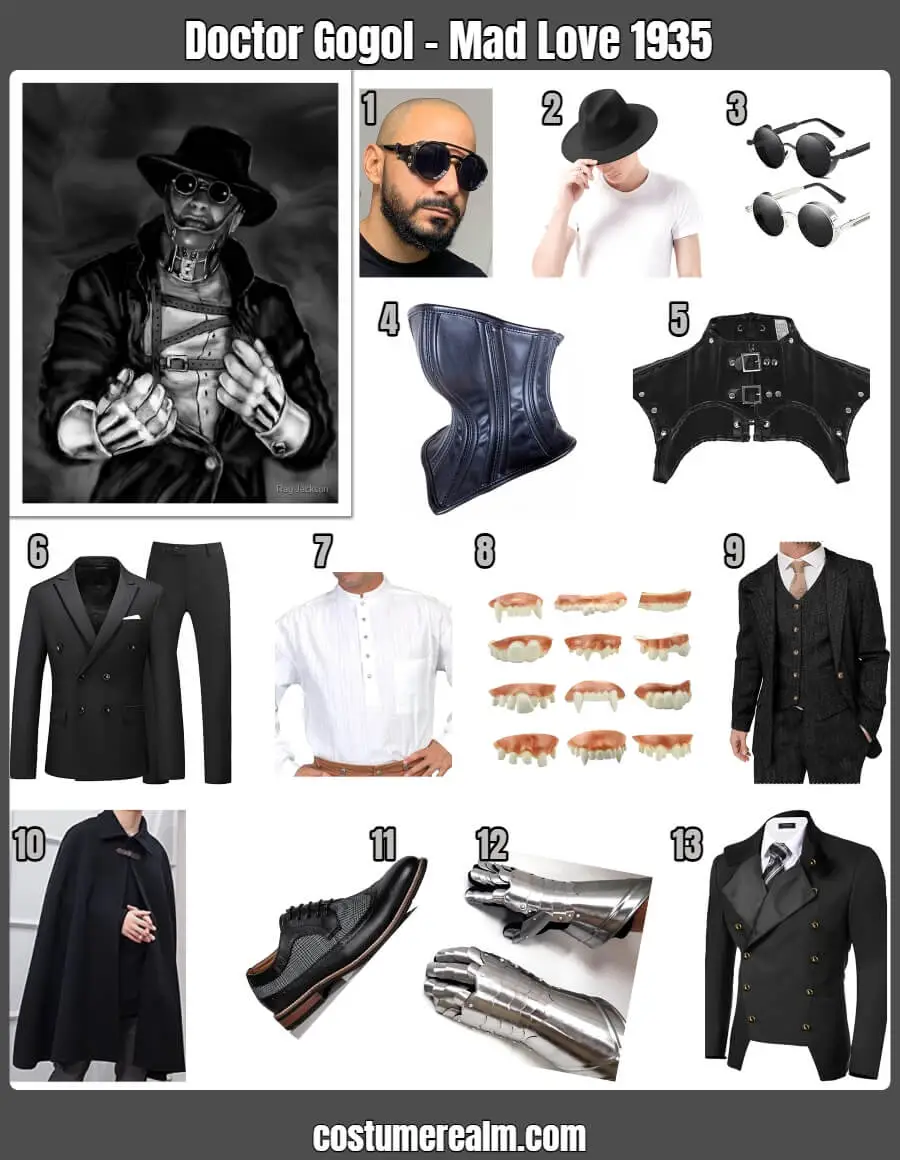
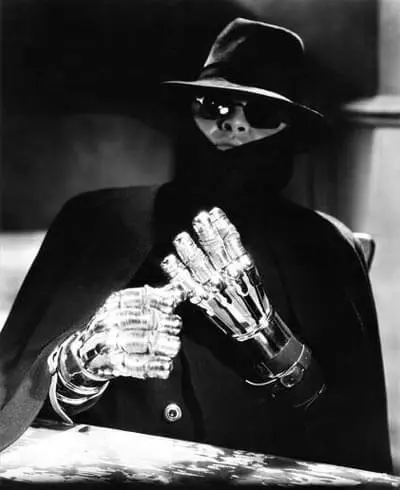
The gauntlets and the face covering need to be in place before you walk in. The fedora pulled low, the glasses covering the upper face, the neck mask covering the lower half. If any one of those three is missing or sitting wrong, the costume stops reading as Gogol’s disguise and starts reading as “man in a hat.” The gauntlets on the table in the film are the image most people associate with the character. They need to be on your hands, where people can see them, not stuffed in a bag because they were awkward on the bus.
In the film, Gogol introduces himself to Stephen Orlac in his disguise and explains that he was once a surgeon whose hands were destroyed. He is calm. He is specific. He is building a lie that uses enough real detail to be convincing, which is what makes him frightening. The costume carries that energy if you stay still more than most people do at a party and let people come to you rather than moving through the room. An android is unsettling when it is too composed. So is Gogol.
The neck mask and glasses cannot fight each other
Put both on at home and check in a mirror that the mask sits flat along the bottom edge of the glasses frame. If there is a gap, light hits your actual nose and the disguise breaks visually. If the mask pulls the glasses down, try a different attachment order: glasses first, then mask looped behind the ears. After two hours of talking, the mask will shift slightly regardless. Check it once an hour.
The gauntlets make social situations specific
At a crowded party, articulated metal gloves make handshakes impossible and holding a drink complicated. That is not a problem to solve. It is the most accurate thing about the costume. Gogol’s claim is that the hands on Stephen Orlac’s arms belong to him. Wearing gauntlets that make normal hand use difficult puts exactly the right emphasis on the hands all night without needing to say a word about it.
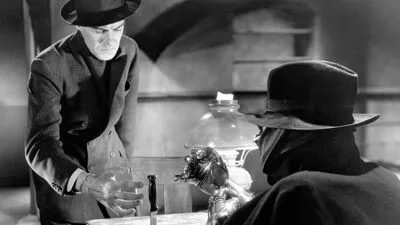
This angle from the film shows something useful: the costume reads from the back too. The wide brim of the hat, the dark coat, and the gauntlets on the table create a silhouette that is distinctive at a distance. You do not need to face someone for them to register that something is off about you. That is worth keeping in mind at a party. Stand at a bar or sit at a table and the costume does work without you needing to perform anything.
The man across the table in the grey suit is Stephen Orlac. If you are building a couples or group version of this costume, that contrast between Gogol’s concealed darkness and Orlac’s conventional dress is exactly what the scene is about.
Group Idea: Mad Love Cast
Excellent concept for a film-literate group. Everyone in this group exists in the same Paris world: a theatre of horrors, an obsessive surgeon, a pianist with a stranger’s hands, and a knife thrower who no longer needs a body. The visual contrast between Gogol’s disguise and Rollo’s carnival performer look is genuinely interesting. The group will need to explain itself at most parties, but the explanation is a good story. No CostumeRealm pages exist for these yet, so every costume in the group is a scratch build.
Group Idea: Classic Horror
Strong concept for a classic horror crowd, with one small caveat: Wolf Man is a 1941 film, not a 1930s one. Dracula, Frankenstein, and The Invisible Man all hit between 1931 and 1933, which puts them squarely in the same Universal horror wave as Mad Love. The group holds together visually because the period silhouettes are similar enough to read as a set. At a general Halloween party, Dracula and Frankenstein will get immediate recognition. Gogol will get questions.
Group Idea: Same Actor
Might work, but only at an event where people know classic cinema well enough to recognize the connection. Hans Beckert in M, Joel Cairo in The Maltese Falcon, Ugarte in Casablanca, and Gogol here span Peter Lorre’s career across four films. The shared idea is that Lorre almost always plays someone whose danger is not immediately obvious. If the group can commit to that and explain it, the concept is interesting. If they cannot, it looks like four unrelated 1930s and 1940s characters.
Group Idea: Niche Horror
Might work, but the group spans several decades and very different recognition levels. Hannibal Lecter is immediately recognizable. Plague Doctor reads visually without context. Herbert West from Re-Animator is known to horror fans. Gogol is the most niche of the four. The concept holds because all four are medical figures whose profession is the source of the horror, which is a genuine shared idea rather than just a loose category. It works better at a horror convention than a general party.
This is a layered concealment build. The difficulty is not in finding individual items; it is in making five separate pieces work as a coherent disguise rather than a pile of accessories.
Gogol in disguise is not a raving villain. He is calm, considered, and specific. His horror comes from how reasonable he sounds while saying things that are not reasonable at all.
The disguise build is the most recognizable version: double-breasted suit, wide-brimmed fedora, dark glasses, a neck mask to cover the lower face, and the metal gauntlets over both hands. The gauntlets are the single visual cue that makes the costume read as Gogol rather than a generic 1930s villain. Everything else is period-appropriate dress.
Recognition will be limited to classic horror fans and cinephiles. Mad Love is not widely screened and most people under 40 have not seen it. The costume holds up visually because the disguise build is striking on its own terms, but do not expect anyone outside a dedicated film crowd to identify it unprompted.
Two lines define him. The first is possessive and cold: “I, Gogol, have saved your hands. They are mine.” The second captures the full scope of his obsession: “Each time you play, it is Gogol who guides your fingers. Gogol who speaks through you to the world.”
Dr. Gogol is played by Peter Lorre in his first American film role. Lorre had already made a mark in Europe with the 1931 Fritz Lang film M (IMDb). Mad Love was directed by Karl Freund and released by MGM in 1935.
Dr. Gogol is a brilliant surgeon obsessed with Yvonne Orlac, an actress at a Paris Grand Guignol theatre. When her husband Stephen, a concert pianist, loses both hands in a train accident, Gogol secretly grafts the hands of an executed knife thrower named Rollo onto his arms. Stephen then begins throwing knives with accuracy he cannot explain, and Gogol uses the situation to try to drive him to madness and claim Yvonne for himself.
The disguise version needs five things working together: the fedora pulled low, dark glasses covering the eyes, a neck mask hiding the lower face, a dark double-breasted suit or coat, and the metal gauntlets on both hands. The gauntlets shift the costume from period disguise to something specific. Without them, it is a man in a hat and glasses.
Yes, and it works best at an event where classic film fans are in the room. Gogol, Hans Beckert from M, Joel Cairo from The Maltese Falcon, and Ugarte from Casablanca cover four decades of Lorre roles. The shared thread is that Lorre always plays someone who seems harmless until he does not. That contrast is the group concept.
Both. The disguise in the film works because the face is entirely covered from every angle: glasses on top, mask on the lower half. Using only one makes the costume look incomplete rather than mysterious. They are both inexpensive enough that cutting one is not worth it.