Halloween Costume Guide
The only costume where forgetting your head is the whole point.
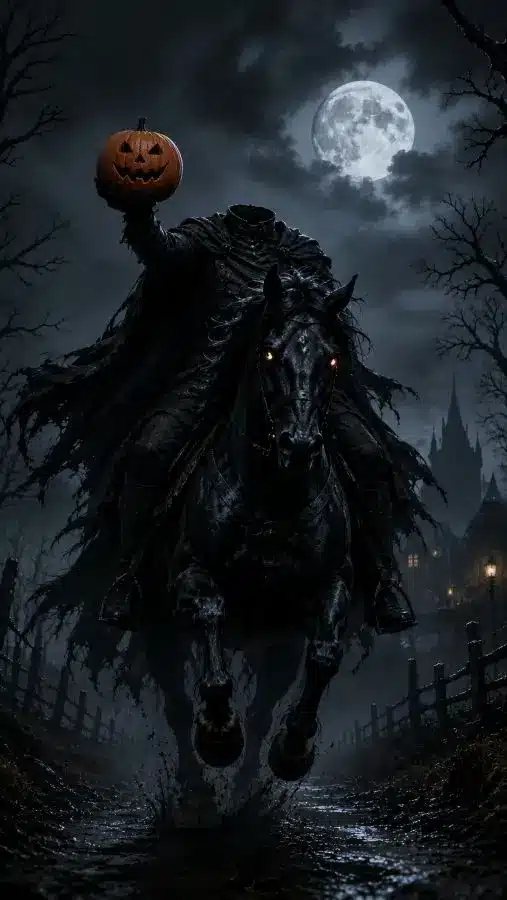
Washington Irving’s “The Legend of Sleepy Hollow,” published in 1820, introduced the Headless Horseman as a decapitated Hessian soldier who rides out of Sleepy Hollow cemetery every Halloween in search of his missing head. You can read more about the original story on the Wikipedia page for The Legend of Sleepy Hollow. The most important piece of this costume is the inflatable shoulder set that creates the headless silhouette. Recognition is about as broad as Halloween costumes get: the Horseman has appeared in Disney animation, a Tim Burton film, a long-running video game event, and two centuries of October storytelling.
Affiliate links. We may earn a small commission at no extra cost to you.
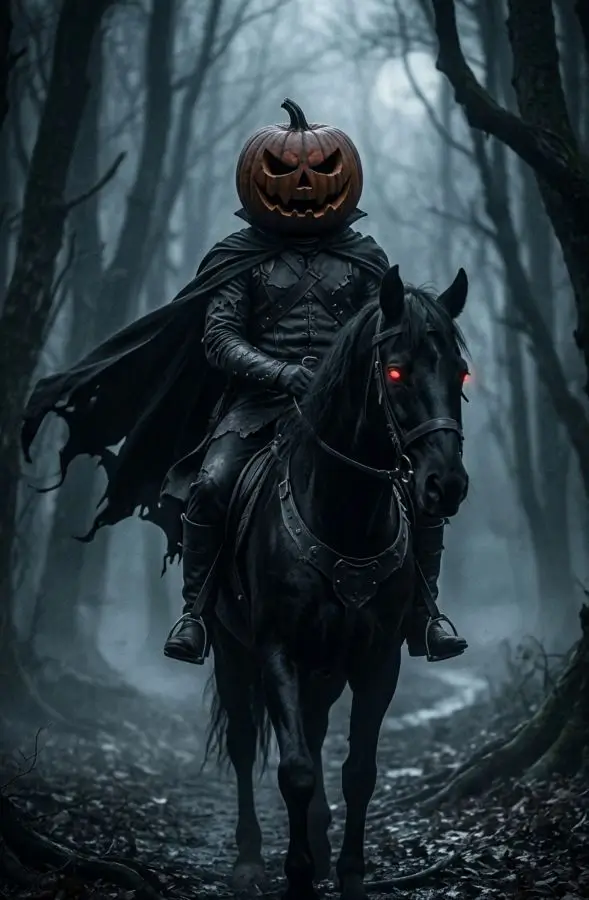
The inflatable shoulders are the first thing people read, so they need to be fully inflated and sitting correctly before you arrive. If they sag or deflate mid-party, the silhouette collapses and you go from “headless specter” to “person whose cape is too big.” The pumpkin mask should sit high on the headpiece, not tilted forward, or the whole effect reads as a mask rather than an absent head. Get someone to check the shoulder height from ten feet away before you walk in. If the shape holds at that distance, it works.
In Irving’s original story, the Horseman doesn’t speak. He hurls his pumpkin head at Ichabod Crane and vanishes. At the party, that’s an option: stay silent, hold the lantern up, turn slowly toward people who look at you. It’s uncomfortable in the best possible way.
Inflate the Shoulders Fully Before You Leave
The inflatable components lose a small amount of air over the course of a night through normal movement. If you inflate them to 80% at home, they’ll read as deflated by midnight. Top them off right before you walk out the door. Bring a small backup pump if the costume includes one. Nobody wants to spend ten minutes in a party bathroom trying to blow up their own shoulders.
Leave the Stick Horse at the Door After Photos
The stick horse is great for the first round of photos. After that, it’s just something you keep accidentally hitting people with. Prop it near the entrance or leave it with a friend who isn’t in costume. The lantern is the prop worth keeping all night: it’s compact, atmospheric, and doesn’t have a four-foot handle.
The Sleepy Hollow Supernatural Society
Strong group dynamic when everyone knows the source material, because the character dynamics actually mean something: the Horseman chases Ichabod, Brom Bones probably faked the whole thing, and Katrina is the reason any of it happened. Most people who grew up with the 1949 Disney version will get it immediately. People who didn’t may just see “colonial party.”
Decapitated Legends and Headless Horrors
Conditional group. The theme is clear and the humor is dark, but the execution depends heavily on how recognizable each person makes their costume. Nearly Headless Nick requires a strong visual trick for the neck, and Marie Antoinette without the neck gag is just a woman in a big wig. The concept lands at a crowd that appreciates historical irony; it falls flat if it needs explanation.
Tim Burton’s Gothic Gallery
Conditional on a note from the brief worth repeating: Tim Burton directed Sleepy Hollow (1999), but Sweeney Todd, Edward Scissorhands, and the Mad Hatter are not from the same film, so this is a “Tim Burton aesthetic” group, not a shared universe group. That’s fine as a party concept, but the visual contrast is strong enough that most people will figure it out. Commit fully to each look or it just reads as four people in dark costumes.
The Horsemen of Legend
Weak unless your group is prepared to do real costume work. The Four Horsemen of the Apocalypse have no single visual standard, which means everyone needs to commit to a specific interpretation and communicate it clearly through costume. War in generic armor, Famine in a torn robe, and Death in a hooded cloak all risk blending together into “guys in dark costumes.” The Headless Horseman is the only one in the group with a truly unmistakable silhouette.
The costume set and pumpkin mask are the two pieces worth buying. Everything below the cape is flexible, and most people already own something that works.
The Horseman doesn’t have lines. That’s either a gift or a problem depending on how comfortable you are with silence at parties.
The all-in-one costume set with inflatable shoulders and the pumpkin mask are the two essential pieces. Without the inflatable shoulders, the headless illusion doesn’t hold. Without the pumpkin, you’re just a person in a dark cape. Add black jeans, Renaissance boots, a vintage lantern, and a stick horse prop to complete the colonial rider look.
The WoW quote is the most theatrical. The Disney one is the most singable. Choose your moment accordingly.
Yes, and it’s one of the few costumes that genuinely fits Halloween rather than just borrowing the occasion. The Sleepy Hollow legend has been around since 1820, gets referenced every October, and the silhouette is distinct enough that recognition is broad without any explanation needed.
The all-in-one kit is the faster path by a significant margin. Building the headless illusion from scratch means sourcing a structured black cape that holds its shape at shoulder height, a balaclava, and a headpiece that keeps the pumpkin elevated. The kit does all of that in ten minutes. DIY takes two hours, maybe more.
The Washington Irving version: colonial-era dark riding attire, cape, and a pumpkin prop. That’s what most people picture. The 1999 Tim Burton film starring Christopher Walken adds a more theatrical and grotesque take if you want to go that direction, but the base silhouette is the same either way.
The lantern. It gives you something to carry, looks atmospheric in photos, and doesn’t require a four-foot handle. The stick horse is worth bringing for photos at the start of the night, then leave it by the door. The pumpkin mask is the more important prop overall because it carries the visual identity of the costume.
Yes. The World of Warcraft version is probably the most played: a seasonal boss during the Hallow’s End event who appears every October delivering rhyming threats while setting a village on fire. He also shows up in Assassin’s Creed III and Assassin’s Creed Rogue, both set in colonial America where the Sleepy Hollow legend fits naturally into the historical setting.