Halloween Costume Guide
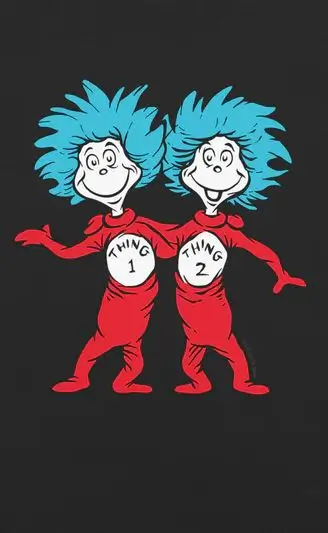
Thing One and Thing Two sprint out of a red box, fly kites inside a house, knock over everything in the room, and get caught in a net before the mother gets home. The numbered chest badge is what separates this from a generic red jumpsuit, and the blue afro wig is what people see from across the room. They first appeared in Dr. Seuss’s The Cat in the Hat, published in 1957, and remain among the most recognized costume pairs at any Halloween event (Wikipedia). This guide covers both a unisex build based on the original illustrated look and a women’s build using a T-shirt and tutu skirt.
Affiliate links. We may earn a small commission at no extra cost to you.
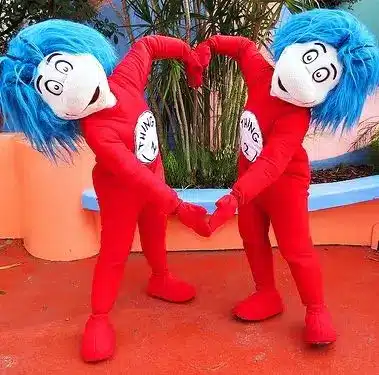
The blue wig is what people identify first, and it needs to be full and upright. A wig that has gone flat or tilted reads as a bad wig rather than a character choice, and once it tilts the numbered badge has to carry the whole costume on its own. The badge is the other critical element: it is what confirms which Thing you are, and it is what tells people this is a deliberate pairing rather than two people who happened to wear the same jumpsuit. If either the wig or the badge is wrong, the couple concept collapses into two individuals dressed in red.
In the book, Thing One and Thing Two are introduced as tame. The Cat says this with full confidence. Within about thirty seconds they have a kite inside the house and the fish is screaming. They are eventually stopped not by persuasion but by a net, which the boy has to chase them down to use. The Cat accepts this development without comment and puts them back in the box.
Confirm badge numbers before buying anything else
This sounds obvious and it is, and people still show up with two Thing Ones every year. The adult costume set includes both numbers in one purchase, which eliminates the problem at the source. If you are building from separate T-shirts or badges, assign numbers in the group chat before anyone orders anything. A Thing One standing next to another Thing One is a different story than the one Dr. Seuss wrote.
Pin the wig before leaving, not when it starts to fall
A full blue afro has enough surface area to catch on door frames, low ceilings, and other people’s costumes over the course of a long night. Two bobby pins at the base of each side of the wig solve this before it happens. Test it at home by walking briskly and turning your head sharply. If it holds through that, it will hold through the party. Fixing a tilted afro wig in a crowded bathroom at midnight is possible but not enjoyable.
Couples Idea
Excellent couples costume because the concept is built directly into the characters. They are a matched pair by design, they have no independent identity from each other in the original book, and the numbered badges make the pairing immediately legible to anyone at any event. This is one of the rare costumes where both people wearing identical outfits is the correct choice rather than a coordination failure.
Duo Idea
Excellent trio with the strongest visual contrast in the Dr. Seuss lineup. The Cat is tall, striped, and wearing a top hat. The Things are compact, identical, and wearing numbers. Three people, three very different silhouettes, one immediately recognizable universe. Adding the Cat also provides the group with a natural narrative anchor: someone who released the Things and now has to deal with the consequences. That is a dynamic that plays well all night.
Group Idea: Dr. Seuss Characters
Strong group for any event with a broad age range. Each character has a distinct color palette and silhouette, which means the group reads as Dr. Seuss from across a venue without anyone needing to stand together. Thing One and Thing Two anchor the group as an already-built pair, which takes pressure off the other costume holders to find a matching partner.
Group Idea: Iconic Mischievous and Chaotic Animated Duos
Might work, but this is five separate duos from five completely different franchises, which means ten people need to commit and coordinate across multiple costume builds. The “chaotic duos” concept holds as a theme but requires someone to run the group chat with genuine authority. At a large themed event with a fixed table, the lineup is visually striking. As a group moving through a venue, expect most people to identify each pair individually rather than as a unified concept, because none of these duos share a visual universe with the others.
One of the most affordable recognizable Halloween builds available. The unisex version is effectively one purchase. The women’s version requires more pieces but most of them are cheap and easy to thrift.
Thing One and Thing Two do not have memorable dialogue. Their whole character is physical: they move fast, they do not acknowledge the rules, and they seem genuinely confused by the concept of consequences. That is a surprisingly playable dynamic at a party.
The red jumpsuit with the numbered chest badge and the blue afro wig are the two elements the costume entirely depends on. Add Thing One and Thing Two socks, red shoes, and you are done. For the women’s build, swap the jumpsuit for the red T-shirt, blue tutu skirt, and red Mary Janes, with the blue wig or blue ponytail head bopper. The badge number is what tells people which Thing you are.
Yes, and it is one of the most reliably recognized couples costumes at any Halloween event. The Cat in the Hat has been in print since 1957, the 2003 film brought the characters to a generation of now-adult Halloween-goers, and the red jumpsuit plus blue afro combination reads immediately across every age group. Recognition is essentially universal.
Not in the original book. They sprint out of the box, fly kites through the house, knock everything over, and get caught in a net without saying anything quotable. In the 2003 live-action film, Dan Castellaneta gave them distinct voices and personality, but the characters are defined by what they do rather than what they say. The blue hair and the chaos are the whole character.
Dan Castellaneta, best known as the voice of Homer Simpson, voiced both Thing One and Thing Two in the 2003 live-action film. The physical roles were played by Danielle Chuchran and Taylor Rice as Thing One, and Brittany Oaks and Talia-Lynn Prairie as Thing Two.
You can, but half the costume concept goes with the missing partner. Solo, you are a person in a red jumpsuit with blue hair holding a number. The recognition works, but the dynamic that makes it interesting disappears. If you are genuinely going alone, carry the plush toy of the other Thing. It closes the loop.
The unisex build uses the full red jumpsuit for a direct match to the illustrated look. The women’s build swaps the jumpsuit for a red T-shirt and blue tutu skirt, with the option of a blue ponytail head bopper instead of the full afro wig. Both builds use the same numbered chest badge and red shoes. The full wig is more immediately recognizable at a crowded event; the head bopper is more comfortable for a long night.
The adult costume set includes both numbered badges in one purchase, which solves the coordination problem entirely. If building from separate pieces, assign the numbers before buying anything else. Thing One is the more frequently recognized number, so if one person is more visible or outgoing at the event, give them Thing One. This is a petty distinction but people will notice.
In The Cat in the Hat, how does the boy finally stop Thing One and Thing Two?
Which actor voiced both Thing One and Thing Two in the 2003 live-action film?
Thing One and Thing Two are also known by what alternate names?