Costume Guide
Now I am become Death. Fedora hat, pipe, and the composed, unsettling certainty of the man who changed the world. Two complete looks from the most celebrated film of 2023.
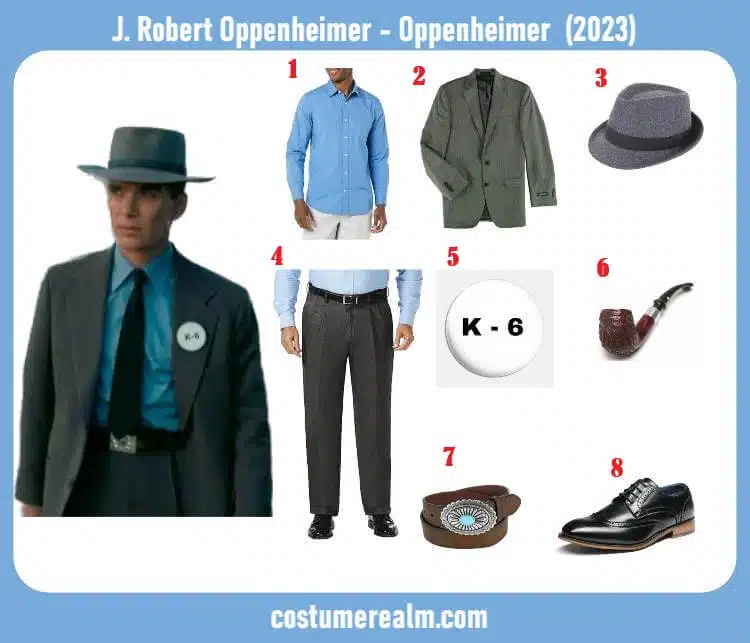
Quick Answer: To dress like Oppenheimer from Christopher Nolan’s 2023 film, choose between two complete looks. For the K-6 badge look: blue dress shirt, wool blend blazer, grey dress trousers, turquoise buckle belt, grey fedora, and tobacco pipe. For the classic formal look: white dress shirt, waistcoat, flannel suit trousers, skinny black tie, wool blend trench coat, black fedora, fake pipe prop, and vintage watch. The fedora is the non-negotiable piece in both builds — without it, either look reads as a generic vintage suit. With it correctly angled forward on the head, the Oppenheimer silhouette is immediate and unmistakeable.
J. Robert Oppenheimer was the American theoretical physicist who served as scientific director of the Manhattan Project, leading the team at Los Alamos, New Mexico that developed the world’s first nuclear weapons during World War II. He witnessed the Trinity test on 16 July 1945 — the first detonation of a nuclear device — and later recalled the Bhagavad Gita verse that became the most quoted line of his life. Christopher Nolan’s 2023 biographical film Oppenheimer, starring Cillian Murphy, covers the Manhattan Project years and Oppenheimer’s 1954 security hearing, in which his loyalty to the United States was questioned and his security clearance ultimately revoked. The film won the Academy Award for Best Picture and Murphy won Best Actor. Oppenheimer’s lean silhouette, fedora hat, and pipe have made him one of the most recognisable Halloween costume subjects of the past two years, offering a rare combination of cultural relevance, historical gravitas, and genuinely elegant 1940s costuming.
Affiliate links — we may earn a small commission at no extra cost to you.
The first decision is which look to build. The K-6 badge look — blue shirt, blazer, grey trousers, grey fedora, and turquoise belt — is the more practical choice for a full Halloween evening. It is less formal, more comfortable for extended wear, and the turquoise buckle belt adds a character-specific detail that distinguishes it from generic vintage menswear without requiring a full three-piece suit assembly. The classic formal look — white shirt, waistcoat, flannel trousers, skinny black tie, trench coat, and black fedora — is the more photographically striking option and the look most people associate with the character from the film’s promotional imagery. For those who already own a dark suit, the classic look can be assembled with minimal additional purchases: black fedora, skinny black tie, and a fake pipe are the only character-specific items required. The three-piece tweed suit is available as a single-purchase alternative to sourcing the waistcoat and trousers separately.
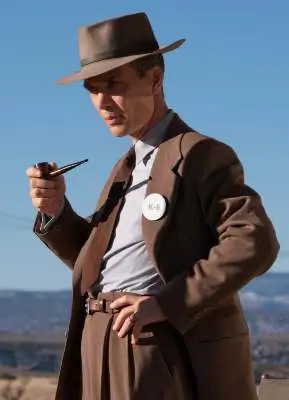
In both builds, the fedora is the piece that requires the most attention. Oppenheimer’s hat in the film sits forward on the head, angled slightly down toward the brow rather than sitting flat and centred. The brim should shade the upper part of the face at a slight angle. This positioning is specific and distinctive — it creates a particular quality of composed, slightly imposing presence that is immediately recognisable as the character’s silhouette even at distance. A fedora sitting flat and centred on the head reads as generic 1940s costume. A fedora sitting forward and angled reads as Oppenheimer.
For the pipe prop, carry it in hand between two fingers rather than clamped in the mouth for the full duration of the event — the hand carry reads as more natural in a social setting and is consistent with how the prop appears in many of the most referenced photographs of the historical figure. For the classic build, wear the trench coat unfastened or half-fastened rather than fully buttoned, which allows the waistcoat and tie beneath to remain visible and contributes to the slightly distracted, intellectually preoccupied quality of the character’s presentation throughout the film.
The Fedora: Angle, Fit, and Period Accuracy
The fedora hat is the most important single piece in either Oppenheimer build and the one that requires the most deliberate attention to wear correctly. Oppenheimer’s hat in the film sits forward on the head with the front brim angled down toward the brow, consistent with the period-accurate wearing style of the 1940s rather than the more upright, casual positioning more common today. When the hat arrives, check the fit: it should sit snugly on the head without requiring constant repositioning during movement. If it is too loose, fold a strip of foam padding or felt and attach it inside the inner band to take up the slack. A correctly fitting fedora that stays in place throughout the evening is significantly more effective than a perfectly styled one that requires constant adjustment. For the grey fedora in the K-6 badge look, the band and any decorative detail should be visible from the front. For the black fedora in the classic look, the brim should be turned down slightly at the front and turned up at the back, creating the specific profile most visible in the film’s most widely circulated images of the character.
Completing the 1940s Silhouette: Fit and Proportion
The Oppenheimer costume depends heavily on proportion and fit in a way that most Halloween costumes do not. A 1940s suit silhouette reads as period-accurate when the trousers sit at the natural waist, the jacket sits at the natural shoulder without padding excess, and the shirt is fully tucked with no visible horizontal wrinkling across the chest. If any of the purchased pieces arrive slightly oversized, which is common with online suit purchases, a tailor can make the key adjustments — trouser waist, jacket side seam, and shirt tuck — in a single session for a cost well within the typical costume budget. The alternative is to cinch the waist of the trouser with the turquoise buckle belt in the K-6 build, which both corrects the fit and adds a character-specific detail simultaneously. For the classic build, the waistcoat provides natural waist definition that compensates for a slightly loose trouser fit as long as the waistcoat itself is correctly sized. Check fit on arrival several days before the event so there is time for any adjustments or exchanges.
From Oppenheimer
The three most cosplayed characters from Christopher Nolan’s 2023 film, covering its central protagonist, its principal antagonist, and its most important supporting relationship. Oppenheimer’s fedora and suit alongside Lewis Strauss’s more conservative, formally composed 1950s business suit and the controlled, sharp-edged elegance of Kitty Oppenheimer’s period wardrobe creates a group with strong visual coherence and a character dynamic drawn directly from the film’s most dramatically rich sequences. The contrast between Oppenheimer’s slightly distracted intellectual presence, Strauss’s cold institutional authority, and Kitty’s fierce protective loyalty gives the group three distinct registers that work naturally in a social setting and reward any fan of the film who encounters them. The hearing room dynamic between Oppenheimer and Strauss in particular is one of the film’s defining narrative tensions and plays effortlessly in a group Halloween context.
Historical & Intellectual Figures
Three of the twentieth century’s most visually recognisable intellectual figures assembled alongside one of television’s most celebrated period drama characters — all sharing the core aesthetic of a carefully composed 1940s or early-to-mid-century suit silhouette with a strong individual detail that makes each one immediately identifiable. Oppenheimer’s fedora and pipe, Einstein’s wild white hair and rumpled suit with the characteristic open-collar informality of his Princeton years, Tesla’s more formal Victorian-adjacent three-piece suit and precisely groomed presentation, and the sharp Peaky Blinders tailoring, flat cap, and quietly threatening composure of Thomas Shelby create a group with remarkable visual variety across four distinct period aesthetics. All four characters share a quality of intense, focused intelligence expressed through deliberate personal style, which gives the group a coherent thematic identity as well as a strong individual visual range.
The Oppenheimer costume is one of the most adaptable Halloween builds available because its components overlap significantly with items many people already own or can borrow. A dark suit jacket and matching trousers, a white or blue dress shirt, and dark dress shoes cover the foundation of either look. The three purchases that convert existing formalwear into a recognisable Oppenheimer costume are the fedora hat, the fake pipe prop, and, for the classic look, the skinny black tie. The turquoise buckle belt is the most specific character detail in the K-6 badge build and the one least likely to be found in an existing wardrobe — it is worth purchasing if the K-6 look is chosen since it provides the single most character-specific visual element in that build. For the classic formal look, any dark wool waistcoat serves as the mid-layer; it does not need to match the trousers exactly, as the trench coat worn over it conceals any minor colour variance.
The Oppenheimer costume is one of the few Halloween builds where the in-character register is as important as the physical appearance, because a man in a fedora and suit could be multiple characters and it is the quality of presence that makes the specific identification clear. Oppenheimer’s register throughout the film is a specific combination of intellectual intensity, physical economy of movement, and a quality of listening that makes his silences as expressive as his speech. He does not fill a room with energy — he focuses it. For a Halloween event, the most effective in-character approach is simple: speak quietly and precisely, listen with complete attention, hold the pipe between two fingers rather than in the mouth, and when the moment presents itself, deliver the Trinity test quote — “Now I am become Death, the destroyer of worlds” — in a low, even tone without theatrical emphasis. The line requires no setup, no explanation, and lands immediately with anyone who has seen the film or has any awareness of the historical figure. It is most effective delivered as a response to a direct question rather than offered unprompted.
Oppenheimer has two signature looks in Christopher Nolan’s 2023 film. The K-6 badge look is his practical working uniform: blue dress shirt, blazer, grey dress trousers, turquoise buckle belt, and grey fedora. The classic formal look is his more composed public-facing appearance: white dress shirt, waistcoat, flannel trousers, skinny black tie, wool blend trench coat, and black fedora. Both looks include the pipe as a carried prop. The fedora is the non-negotiable piece in either build and the item that most immediately establishes the character’s silhouette.
J. Robert Oppenheimer is played by Cillian Murphy in Christopher Nolan’s 2023 biographical film Oppenheimer. Murphy won the Academy Award for Best Actor for the role. The film won Best Picture and Best Director and covers Oppenheimer’s leadership of the Manhattan Project, the Trinity test, and his 1954 security hearing. Murphy’s physical transformation and period costuming made the character one of the most imitated Halloween costume silhouettes of the 2023 and 2024 seasons.
Oppenheimer’s most famous quote is his recollection of the Bhagavad Gita verse upon witnessing the Trinity test: “Now I am become Death, the destroyer of worlds.” It is one of the most quoted lines in the history of science and one of the defining moments of Nolan’s film. His remark that “there are children playing in the streets who could solve some of my top problems in physics, because they have modes of sensory experience that I have lost long ago” reflects his philosophy on creativity and scientific thinking. For a Halloween event, the Trinity quote delivered in a low, even tone in response to an appropriate moment is the complete in-character line and requires no context for anyone with a passing awareness of the character.
The K-6 badge look is recommended for most Halloween events: more comfortable for extended wear, less formal, and the turquoise buckle belt adds an immediately character-specific detail. The classic formal look — three-piece suit, black fedora, trench coat, and skinny black tie — is the more striking option for photography-focused occasions or shorter events. In both builds, the fedora angled forward on the head is the non-negotiable piece. Without it, either look reads as generic vintage menswear. With it correctly positioned, the Oppenheimer silhouette is immediate.