Halloween Costume Guide
No introduction needed. That is the whole point.
The Grim Reaper collects the dead. That is the entire job description, and it has been the same across cultures for centuries. The figure appears in Western folklore as a cloaked, skeletal being carrying a scythe, and has been represented in everything from Ingmar Bergman’s 1957 film The Seventh Seal to the animated series The Grim Adventures of Billy & Mandy (Wikipedia). The costume works because the figure needs no origin story, no franchise, and no recent release to be recognized. Everyone already knows what it is.
Affiliate links. We may earn a small commission at no extra cost to you.
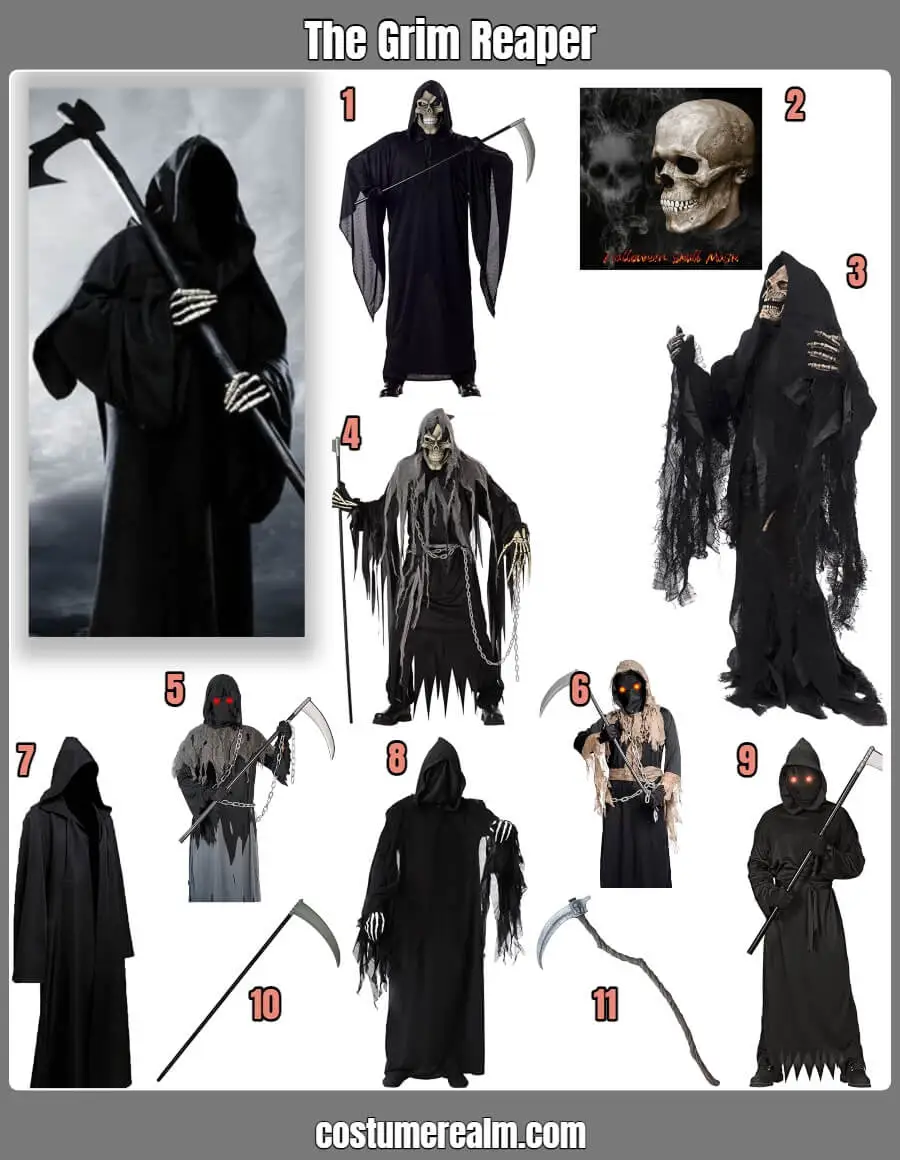
The hood is what people see first, and it has to do one thing: make your face disappear. In a well-lit room, most hoods do not fully shadow the face. That is when the mask earns its place. If you are relying on shadow alone and it fails, you are a person in a black robe holding a large farm implement. Pull the hood as far forward as it goes before you leave the house, stand under a normal ceiling light, and check whether your face is visible. If it is, put the mask on.
The Grim Reaper does not speak unless necessary, and when he does, it tends to be calm and final. That is the character at the party. No nervous energy, no explaining yourself. Hold the scythe upright, move slowly, and let people come to you. William Sadler’s version in Bill and Ted’s Bogus Journey is the funniest reading of this character in any medium, and his whole joke is that Death takes himself completely seriously while losing at board games (IMDb). That energy translates better than you might expect.
The scythe at a crowded party
A full-length scythe is about six feet of rigid prop. At a busy party, you will knock things over. You will hit people. You will spend the first hour either apologising or holding it horizontally at your side like a very long rifle. Decide before you go in whether you are committed to carrying it all night, or whether you leave it propped in a visible corner and walk over to it when someone asks about the costume. The second option is more honest about how parties actually work.
Robe length and footwear
A robe that reaches the floor hides your shoes, which is useful because no footwear actually looks right with this costume. It also means you will step on the hem repeatedly. Either hem it two inches above the floor before the party, or wear shoes with a slight heel to keep the fabric off the ground. Sandals under a Grim Reaper robe, if someone sees them, will get a comment. Usually not the one you want.
Group Idea: Animated Trio
Excellent group for anyone who grew up watching Cartoon Network in the 2000s. The concept is specific: the Grim Reaper lost a limbo contest to two children and is now contractually obligated to be their best friend. That is the entire premise of the show, and it makes the group dynamic immediately legible to anyone who watched it. Recognition at a general party in 2026 will depend heavily on the age range of the crowd. Under 35, it will land well. Over 45, you may need to explain it.
Group Idea: Dark Cloaked Silhouettes
Strong visual group because all four share the same silhouette logic: dark cloak, hidden face, immediate dread. The contrast between them is more interesting than it sounds. Ghostface is a teenager in a costume. A Dementor is a soul-sucking specter. A Nazgul is an ancient king reduced to shadow. The Grim Reaper is something else entirely. Side by side, the differences become obvious. This works at any party because the individual costumes are all recognizable on their own.
Group Idea: Same Actor
Might work, but only at a party where people care about character actors. William Sadler played the Grim Reaper in Bill and Ted’s Bogus Journey, Heywood in The Shawshank Redemption, Colonel Stuart in Die Hard 2, and President Matthew Ellis in Iron Man 3. The concept is a meta-joke about range: one actor, four wildly different roles. The joke lands immediately for film people and requires a full explanation for everyone else. Worth doing if your group is genuinely into it, but do not expect the crowd to do the work for you.
Group Idea: Mythological Afterlife Guides
Might work, but this group needs the right event. Four figures associated with death across different mythologies and fictional universes: Western folklore, Egyptian mythology, Greek mythology via Disney, and manga. The concept is coherent on paper. In practice, Anubis requires a built costume, Ryuk requires a very specific Death Note build with wings and apple, and Hades from Disney’s Hercules is the only one most people will name immediately on sight. If everyone commits to accuracy, this is a striking group. If someone cuts corners on Ryuk, it reads as four unrelated costumes.
This is one of the simpler Halloween builds available. The parts are few and the silhouette is forgiving. The main risks are a robe that is too short and a face that is too visible.
The Grim Reaper is not threatening. He is patient. That is the character detail most people miss. He has all the time in the world, because time is literally his domain.
Start with a full black hooded robe that hides the face completely. Add a scythe, because without it you are just a person in a black robe. A skull mask or hollow face covering finishes the look. The hood and the weapon are what make it readable from across a room.
Yes, and for a specific reason: it requires no explanation. Every person at the party knows what it is before you say a word. It is one of the few Halloween costumes where recognition is genuinely universal and does not depend on whether someone watched a particular show last year.
The most quotable version is William Sadler’s in Bill and Ted’s Bogus Journey, where Death loses at Clue, Battleship, and Twister and storms off shouting “Best of seven!” The philosophical version appears in Ingmar Bergman’s The Seventh Seal, where Death plays chess with a knight over the fate of his soul. Neither is the same character, but both show how much range the concept carries.
A plain hood works if it genuinely obscures the face in shadow. Most hoods do not actually do this in normal lighting. The skull mask removes the ambiguity. Without something covering the face, a black robe reads as a Halloween robe, not as Death.
For most people, the full costume set is the right call. The robe proportions matter more than they look like they do on a product page, and a matching set is designed to work together. Building from separate pieces gives you more control but takes more time and can end up costing more.
The glowing red scythe is more visible at a dark party and gives you something to point with when someone does not immediately understand the costume. The standard scythe looks more accurate in photos taken in normal light. Both work. The glowing version is more practical in low-light venues.