Halloween Costume Guide
Five items, zero explanation needed, and one of the few costumes that has been politically relevant for over 80 years.
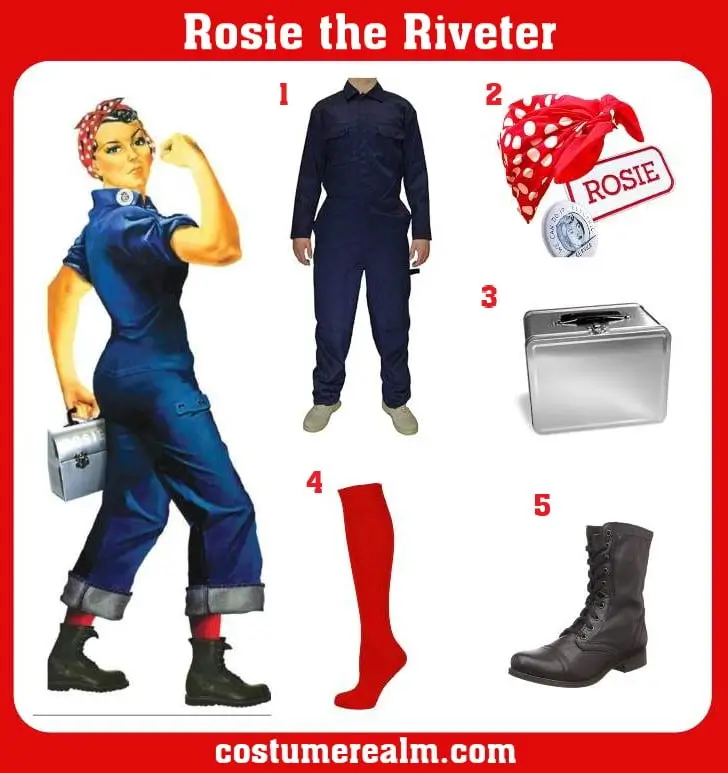
Rosie the Riveter is a cultural icon representing the millions of American women who entered factory and shipyard work during World War II, many of them building bombers and warships while the men were overseas. The red polka dot bandana is what makes the costume work; everything else is context. She is based on two separate images: the J. Howard Miller “We Can Do It!” Westinghouse poster of 1943 and Norman Rockwell’s Saturday Evening Post cover from the same year. Most people picture the Miller poster, which is the one you are building here.
Affiliate links. We may earn a small commission at no extra cost to you.
The bandana placement is the first thing people clock. Too far back on the head and it reads as a regular bandana; pulled forward to cover the hairline with the knot centered at the forehead is the specific Rosie silhouette. Get that right and the rest of the costume follows. If the boilersuit sleeves are not rolled up by the time you arrive, roll them on the way in. A flat-sleeved boilersuit reads as coveralls, not a costume.
Rosie’s defining move is not actually the flexed arm pose. She is a factory worker who built B-24 bombers and B-17s while the country needed her to, without being asked twice. The attitude is quiet competence, not performance. If someone at the party is being unnecessarily complicated about something simple, the look Rosie gives them in the Miller poster is entirely appropriate.
Write “Rosie” on the Lunchbox
A plain metal lunchbox is half the reference. In the Rockwell painting, the lunchbox lid reads “Rosie,” which is what connected the image to the song for audiences at the time. A strip of masking tape and a marker takes 30 seconds and adds an immediate visual anchor that most people will recognize even if they cannot place the Rockwell painting specifically.
The Bandana Knot Placement Matters
The knot goes at the front center of the forehead, not at the nape of the neck like a typical bandana. A lot of Rosie costumes get this wrong and end up looking like a pirate headscarf. Fold to a triangle, place the long edge along the hairline, bring the two ends forward and tie them over the top of the folded edge. The resulting knot sits visibly at the front.
We Can Do It: WWII Home Front Heroes
Strong group concept for anyone willing to lean into WWII home front history as a theme, because the visual variety across wartime roles is genuinely interesting and each costume is distinct. The catch is that most of these characters need to be built from scratch rather than bought as kits. Anyone in this group who shows up in a generic costume without a clear historical reference will read as “person in vintage clothes,” which dilutes the concept. Commit fully or keep the group smaller.
Icons of Empowerment: Feminist Trailblazers
Conditional group because the connection is thematic rather than from a shared universe, and the costumes vary wildly in how much effort they require. Wonder Woman and Rosie are immediately recognizable to anyone. Joan of Arc in full armor, Amelia Earhart in a leather flight jacket, and Frida Kahlo with the flower crown are each recognizable to most, but only if the costume is executed clearly. This group works well when everyone commits to accuracy; it falls apart when half the group goes vague.
Propaganda Poster Power: Iconic Visual Symbols
Conditional group that requires a crowd who appreciates the concept of “people dressed as propaganda posters.” Uncle Sam is instantly recognizable and anchors the group; Lord Kitchener and the Soviet Worker will need some explaining to most American audiences. The concept is genuinely clever, but it lands best at a party where people will actually engage with it. At a loud venue where nobody reads a costume closely, it just looks like five people in old-fashioned clothes.
This is one of the more DIY-friendly Halloween costumes out there. The boilersuit and boots are the main purchases; several other pieces can be pulled from existing wardrobe or made in minutes.
Rosie’s most famous pose is one flexed arm, chin slightly down, direct eye contact. It photographs well with no preparation and communicates the character in a single gesture. Beyond the pose, Rosie is not a performative character; she is someone who showed up and did the work.
You need five items: a dark blue boilersuit, the Rosie accessory kit with polka dot bandana, badge, and pin, a metal lunch box, red knee-high socks, and lace-up boots. The boilersuit and the red polka dot bandana are the two essential pieces. Without both, the costume reads as generic workwear rather than Rosie specifically.
It is worth knowing that the “We Can Do It!” poster was never actually titled “Rosie the Riveter” during the war. J. Howard Miller created it for Westinghouse in 1943 as an internal morale poster; it was rediscovered in the 1980s and only then became associated with the Rosie icon. Say it flatly at a party and it lands better than saying it as a rallying cry.
Yes, and it is one of the most broadly recognized Halloween costumes that exists. The “We Can Do It!” image has been reproduced so widely across so many decades that essentially everyone will place it immediately. It also holds up politically and culturally in a way that many pop culture costumes do not, which means it ages differently from most.
In the Miller “We Can Do It!” poster she wears a dark navy work shirt with a red polka dot bandana. In the Norman Rockwell Saturday Evening Post painting she wears blue overalls with various pins and badges on the chest. Most Halloween costumes are based on the Miller version, which is the more widely recognized of the two. Either reads immediately.
Rosie is a composite cultural icon rather than one specific person. Several real women have been identified as possible inspirations, including Rose Will Monroe, who built B-24 bombers at the Willow Run Aircraft Factory in Michigan, and Naomi Parker Fraley, whose photograph is now believed to be the basis for the Miller “We Can Do It!” poster. The identity has been debated for decades. The U.S. Department of Labor’s history page covers the debate in detail.
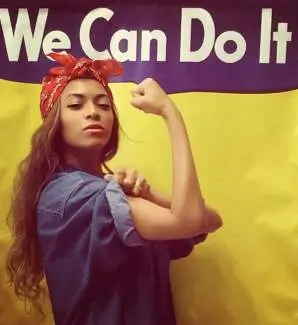
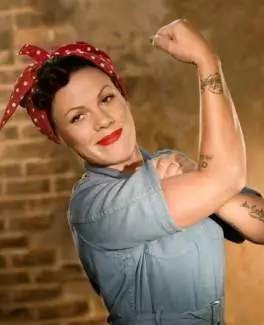
Beyonce paid tribute to Rosie in July 2014, posing in front of a “We Can Do It!” sign; the photo received over 1.15 million likes and sparked a minor public debate about the icon’s feminist legacy. P!nk dressed as Rosie for part of her 2010 “Raise Your Glass” music video. Katy Perry also paid tribute in her 2024 “Woman’s World” video.
Yes. The boilersuit is unisex and the accessory kit works on any build. The costume is defined by the silhouette and the bandana, not a gender presentation, and it reads immediately on anyone. It is also one of the rare Halloween costumes where a group of men in matching Rosie outfits is funnier than confusing.