Costume Guide
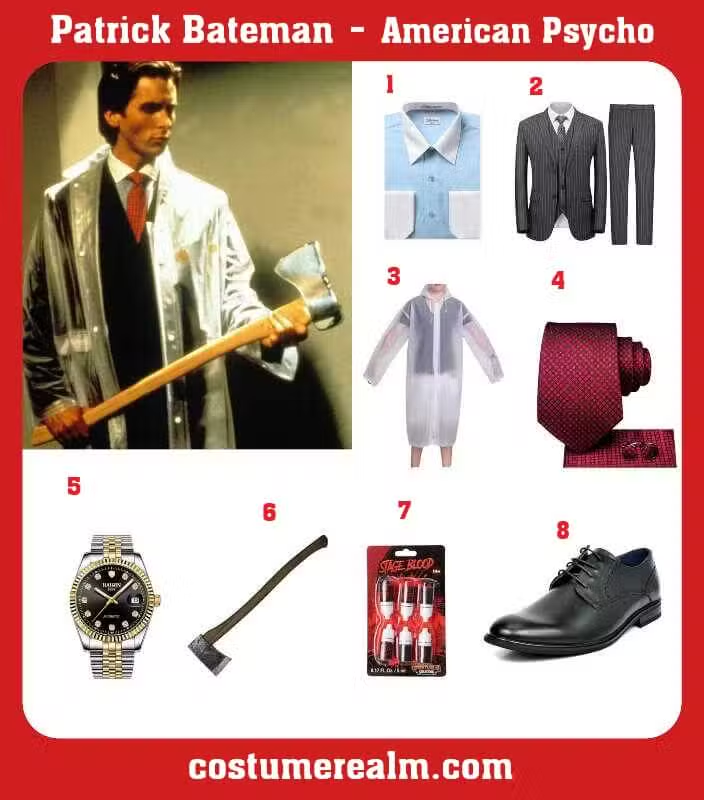
Black pinstripe suit, light blue dress shirt, red tie, transparent raincoat, leather Oxfords, a two-tone watch, a foam axe, and enough stage blood to make the business card presentation feel secondary.
Patrick Bateman is the protagonist of American Psycho, the 2000 film directed by Mary Harron and based on the 1991 novel by Bret Easton Ellis. Played by Christian Bale, Bateman is a wealthy Manhattan investment banker who presents a flawless image of 1980s professional success while describing extreme violence in the same detached, precise tone he uses to discuss morning skincare routines and business card fonts. His costume is one of the most recognisable and most referenced in Halloween history, amplified by the character’s second wave of cultural reach as a major internet meme in the 2020s.
Affiliate links. We may earn a small commission at no extra cost to you.
Start with the light blue and white dress shirt tucked neatly into the black pinstripe suit trousers. Fasten the red tie at the collar with a clean, tight knot. Put on the suit vest over the shirt, then the suit jacket. Fasten the two-tone watch on the left wrist. Put on the leather Oxford dress shoes, clean and polished. Everything under the raincoat should look immaculate, because Bateman’s whole point is that the surface is perfect.
Pull the transparent raincoat on over the complete suit. Apply stage blood to the front and sleeves of the raincoat in a splatter pattern, and apply a smaller amount to both hands. Carry the foam axe in one hand and keep a Patrick Bateman business card in the breast pocket of the suit jacket, accessible through the open front of the raincoat. For in-character delivery, Bateman’s register is smooth, controlled, intensely focused on surface details, and slightly too attentive for the situation. The business card presentation is the complete in-character performance: offer it with complete seriousness, wait for a reaction, and then scrutinise the recipient’s card with barely concealed competitive anxiety.
The Stage Blood: Raincoat and Hands Only
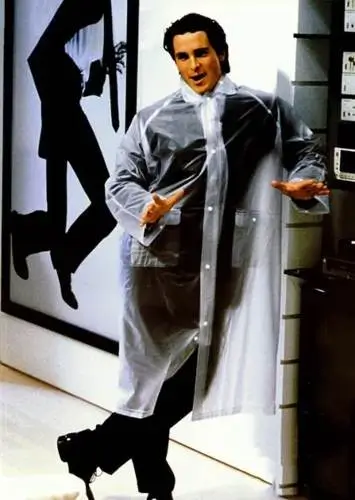
Apply stage blood to the transparent raincoat and the hands, not to the suit underneath. The visual logic of the raincoat scene is that Bateman is wearing the coat to protect the suit, so the bloodshed is on the outer layer while the pinstripe suit beneath remains pristine and visible through the clear plastic. Use a splatter technique on the raincoat front and sleeves rather than broad smears, applying the blood while the coat is laid flat before putting it on. Apply a smaller amount to both hands and allow it to dry slightly before handling the axe prop. Stage blood is washable from most fabrics but check the care label of the raincoat before applying.
The Business Card: The Most Effective In-Character Prop
The Patrick Bateman business card is the single most effective in-character prop for a Halloween event and requires no physical effort to carry. Keep the card in the breast pocket of the suit jacket and produce it with complete seriousness when introduced to anyone new. The business card scene in the film is built entirely on the intensity with which Bateman and his colleagues treat a trivial status detail, so the in-character performance is simply to hand over the card, wait for a response, and then examine the other person’s card, or phone, or drink, or costume, with the same level of scrutiny. The more ordinary the target of Bateman’s attention, the more effective the performance.
Fictional Serial Killers
Four of fiction’s most iconic and most costumed killers, each with a completely different aesthetic and a shared quality of performing normalcy over something far darker. Bateman’s Wall Street suit and raincoat, Hannibal’s clinical precision, Dexter’s blood spatter technician coveralls, and Sweeney’s Victorian barber aesthetic create a group with exceptional visual variety and immediate recognition from any Halloween crowd familiar with prestige horror.
Slasher Icons
Four of the most recognisable figures in horror, from the domestic suburbia of Halloween to the rural isolation of The Texas Chain Saw Massacre, the basement dread of The Black Phone, and the polished Manhattan streets of American Psycho. Bateman’s suit and raincoat is the outlier in this group visually, and that contrast with three classic horror silhouettes makes the group more striking and more interesting as a Halloween ensemble than four matching aesthetic choices would be.
Horror Antiheroes
Four horror characters who occupy the space between villain and protagonist, each carrying a background that complicates a straightforward reading of their violence. Bateman’s satirical Wall Street monster, Tate’s haunted and manipulative American Horror Story ghost, the slasher camp killer Mr. Jingles, and Nina the Killer from the creepypasta tradition create a group built around horror characters with devoted fan followings and strong individual visual identities.
Villains in Civilian Clothing
Four characters whose Halloween costumes share an important quality: they all look like something else first. Bateman looks like a businessman, The Riddler looks like an eccentric office worker, Dahmer looks like a quiet neighbour, and Hannibal looks like a distinguished doctor. The group is built around the theme of horror wearing a civilian face, and together the four create a Halloween ensemble that rewards a second look from anyone who recognises the characters beneath the surface presentation.
The Patrick Bateman costume is one of the most wardrobe-friendly Halloween builds for anyone who owns or has access to a dark suit. Any black or dark charcoal suit substitutes well for the pinstripe three-piece if a pinstripe is not available. Any light blue dress shirt works as the base layer. A red tie is a common wardrobe item. The transparent raincoat is the highest-priority dedicated purchase because it is the only element that cannot be substituted with something already owned and is the item that transforms a suit into a Patrick Bateman costume. Stage blood and a foam axe are both inexpensive additions. The business card prop is optional but high-value for in-character performance and very low cost.
The women’s Patrick Bateman costume follows the same visual logic as the men’s version with three direct substitutions: a black formal skirt suit or trouser suit in place of the pinstripe three-piece, a red bow tie in place of the red tie, and ankle strap high heels in place of the leather Oxford shoes. The transparent raincoat, blue dress shirt, two-tone watch, foam axe, and stage blood are identical across both builds. The skirt suit option gives a slightly more distinctive silhouette at a Halloween event, while the trouser suit reads as closer to the men’s version for a more direct character reference. Both work equally well. Stage blood application follows the same logic: coat and hands, not the suit beneath.
For Halloween 2026, the Patrick Bateman costume is built from the American Psycho raincoat scene: a black pinstripe three-piece suit, a light blue and white dress shirt, a red tie, a transparent raincoat over the suit, leather Oxford shoes, a two-tone watch, a foam axe, and stage blood on the coat and hands. The transparent raincoat over the pinstripe suit is the combination that immediately communicates the character. A Patrick Bateman business card prop adds the most effective in-character detail for any Halloween event.
Patrick Bateman’s most iconic lines include his business card scene delivery, his opening narration about existing only as a surface, and his excusing himself from any conversation with “I have to return some videotapes.” For Halloween in-character performance, produce the business card with complete seriousness, examine the recipient’s phone or costume with barely concealed competitive anxiety, and respond to any question about what you do with a job title delivered as though it is the most important information in the room. Bateman’s register is smooth, controlled, and slightly too focused on surface details for the situation.
Patrick Bateman’s most costumed look is the transparent raincoat scene: a black pinstripe three-piece suit, a light blue and white dress shirt, a red tie, a clear plastic raincoat over the suit, leather Oxford shoes, and a two-tone watch. Stage blood and a foam axe complete the Halloween version. He is also known for his morning skincare routine in a white robe and his various immaculate business suits throughout the film.
Patrick Bateman is the protagonist of American Psycho, the 2000 film directed by Mary Harron and based on the 1991 novel by Bret Easton Ellis. Played by Christian Bale, he is a wealthy Manhattan investment banker in the 1980s who presents a flawless image of professional success while describing violence in the same detached, precise tone he uses to discuss skincare and business cards. Christian Bale’s performance made Bateman one of the most referenced characters in Halloween history, a reach amplified significantly by the character’s rise as a major internet meme in the 2020s.
Yes. The core costume is a dark suit and a clear raincoat. Any dark pinstripe or charcoal suit works as the foundation. The transparent raincoat is the only dedicated purchase with no wardrobe substitute, and it is widely available and inexpensive. Stage blood and a foam axe are both low-cost additions. Total cost typically runs $60 to $120 depending on suit quality and whether a suit is already owned.
Yes. The women’s Patrick Bateman Halloween costume uses a black formal skirt suit or trouser suit, a blue dress shirt, a red bow tie, a clear raincoat, a two-tone watch, ankle strap high heels, a foam cosplay axe, and stage blood. The same raincoat and stage blood logic applies: coat and hands, suit pristine beneath. The women’s version has the same immediate recognition as the men’s, and the character’s appeal as a Halloween costume has grown significantly with the meme era.