Halloween Costume Guide
All black. No explanation needed. Except maybe an explanation.
Viktor Tsoi wrote and performed some of the most enduring protest songs to come out of the Soviet Union, fronting the Leningrad band Kino from the early 1980s until his death in a car accident in 1990 at 28 (Wikipedia). The jacket is what holds this costume together. His look was consistently dark, layered, and unstyled in a way that looked very intentional, and the hair was a large part of it. Outside of Eastern European and post-Soviet communities, this is a niche costume, so know your crowd before you commit.
Affiliate links. We may earn a small commission at no extra cost to you.
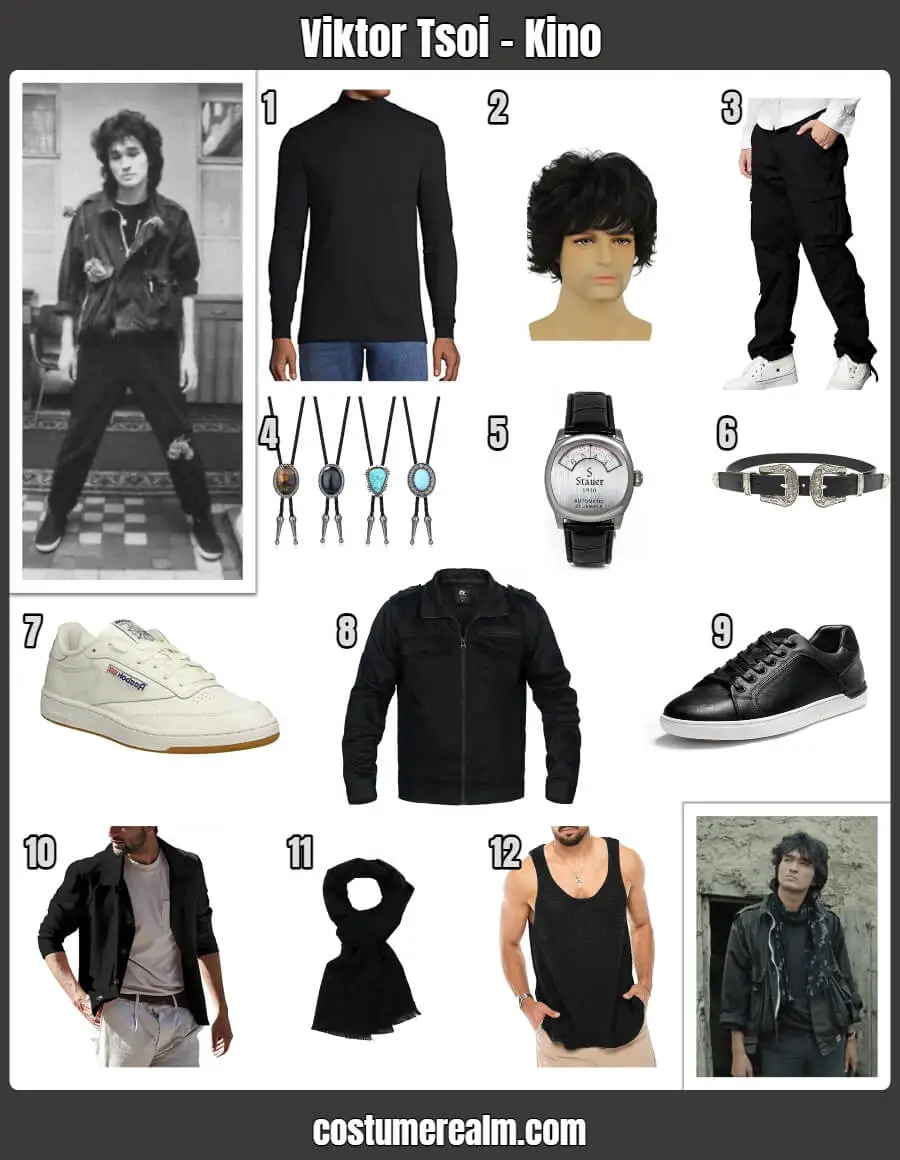
The jacket is the first thing people see, and it has to look like it belongs to the person wearing it, not like something grabbed off a rack that morning. Tsoi’s outerwear always looked worn-in. A military jacket that is too stiff or too obviously new will pull the whole look toward “costume” rather than “character.” If the jacket does not sit right, the rest of the items do not matter much. The hair is close behind it: without the dark volume, the costume reads as someone in black clothes, which is not the same thing.
There is a clip of Tsoi performing “Gruppa Krovi” in 1988 where he barely moves. He stands at the microphone, delivers the line about blood type on his sleeve, and the crowd responds like he said something profound, which he did. That stillness is the character at the party. He was not a performer who worked the room. He said what he was going to say and let it land.
The necktie will not stay where you put it
A loosely worn necktie at a Halloween party will migrate over the course of the evening. It will end up behind your shoulder, tucked into the jacket, or held by a stranger who thought it was a prop. Either pin it lightly to the turtleneck with a small safety pin hidden underneath, or accept that maintaining it will be a recurring task through the night. The tie adds something to the look, but not so much that you need to stress about it every twenty minutes.
Know one or two Kino songs before you go
At a general Halloween party, most people will ask “who are you?” before they ask “are you Tsoi?” Having a line ready helps: “Soviet rock musician, 1980s Leningrad, wrote protest songs that became anthems after the USSR collapsed.” That is enough context for most conversations. If someone actually knows Kino, the fact that you can hum “Khochu Peremen” will do more for the costume than any item on this list.
Group Idea: Kino Band
Excellent concept for a group that is deep in Soviet rock history or willing to be. Yuri Kasparyan, Igor Tikhomirov, and Georgiy Guryanov all shared Tsoi’s general dark, layered aesthetic, which makes the group visually coherent even if no one outside the group knows exactly who each person is. At most Western Halloween parties, this reads as “Soviet rock band” and stops there. At a post-Soviet community event or a music-specific gathering, it reads correctly, and the response will be proportionate.
Group Idea: Rock Icons
Strong group if everyone commits to the right reference. Freddie Mercury, Axl Rose, and David Bowie are all widely recognised, which means the group reads to a general crowd even if Tsoi is the one name they do not place. The visual contrast between the four costumes is genuinely good: Bowie’s theatricality, Mercury’s stage presence, Rose’s attitude, and Tsoi’s stillness. The risk is that Tsoi gets a lot of “and who are you?” while the others get immediate recognition, which is accurate to the historical situation but might get old by midnight.
Group Idea: Same Name
Might work, but only if everyone is comfortable explaining the concept throughout the night. The connection is the name Viktor and its variants, which is a concept that lands immediately with people who enjoy that kind of meta group idea, and draws blank looks from everyone else. Victor Creel and Viktor from Arcane have enough current recognition to pull their weight. Vector is niche enough that the person wearing it will need to explain both the name connection and the character. The group works best at a party where people actually want to talk about costumes.
Group Idea: Eastern Bloc Theme
Might work, but the group concept is held together loosely. Danila Bagrov is a genuine Russian cultural icon and sits naturally next to Tsoi. Black Widow and Red Guardian are Marvel characters with Soviet backstories, which gives the group its thematic logic, but they are film characters rather than icons of Soviet culture. At a general party, the group reads as “Russia-themed costumes” which is coherent enough. Anyone who knows the source material for all four will appreciate the specificity. Anyone who does not will see three people in very different costumes standing next to someone in all black.
This is one of the more accessible builds on this site. Almost everything either comes from your wardrobe or from a basic Amazon order. The challenge is not sourcing the items; it is making sure they work together as a specific person rather than a generic dark aesthetic.
Tsoi was famously reserved in interviews and on stage. He did not perform charisma; he performed certainty. There is a difference, and it is the one the costume needs to reflect.
Start with a black military jacket or blazer over a black turtleneck or tank top. Add dark cargo pants, a handmade necktie worn loosely, and a vintage watch. The hair matters more than any single clothing item: dark, voluminous, and slightly unkempt. Black sneakers finish it.
In post-Soviet countries and among Eastern European communities, recognition is near-total. In Western Halloween crowds, most people will read “dark moody rock musician” and not much more. The costume works on its own visual terms, but do not expect it to land as Viktor Tsoi specifically outside of niche contexts.
Tsoi’s words survive mostly through his lyrics. The most quoted line is from “Khochu Peremen”: “Peremeny! Trebuyut nashi serdtsa!” — Change! Our hearts demand change! Another is from “Gruppa Krovi”: “Gruppa krovi na rukave, moy poryadkoviy nomer na rukave” — Blood type on my sleeve, my service number on my sleeve. These became protest anthems well beyond what Tsoi originally intended for them (Wikipedia).
Viktor Tsoi was the lead singer and songwriter of the Soviet rock band Kino, formed in Leningrad in the early 1980s. Of Korean descent, he became one of the most iconic figures in Soviet rock history. He also acted in several films, most notably Igla (The Needle) in 1988. He died in a car accident in 1990 at age 28.
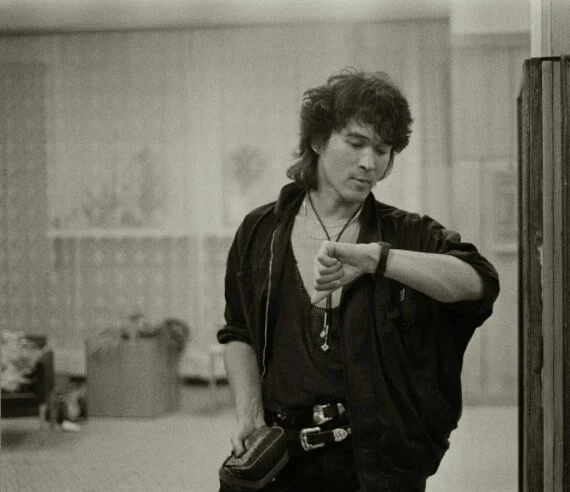
He wore dark, layered clothing almost exclusively: black jackets, turtlenecks, and plain trousers. His hair was dark, full, and slightly tousled. He wore a wristwatch consistently and kept accessories minimal. The overall effect was less styled and more like someone who simply always dressed this way.
If your hair is already dark and can be given volume and a slight wave, the wig is unnecessary. The wig matters most if your hair is light-coloured or very short and flat. Tsoi’s hair was one of the more recognisable parts of his appearance, so it is worth getting right.