Halloween Costume Guide
Eeyore wanders the Hundred Acre Wood expecting things to go wrong and being rarely surprised when they do. He is a grey stuffed donkey with a tail that keeps falling off, a stick house that keeps getting knocked over, and a remarkably dry sense of humor about all of it. He first appeared in Disney’s 1966 short “Winnie the Pooh and the Honey Tree” (Wikipedia) and has been one of the franchise’s most recognizable characters ever since. The pink bow on his tail is the one detail that separates this from a generic grey donkey costume.
Affiliate links. We may earn a small commission at no extra cost to you.
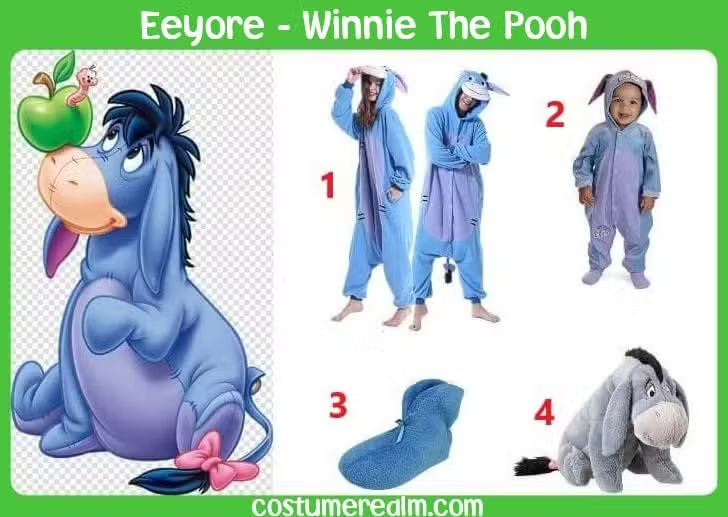
The onesie and the pink bow work together as the recognition signal. The onesie alone reads as grey donkey; the bow reads as Eeyore. Make sure the bow is visible at the back of the costume โ if it gets tucked in or covered, it stops doing its job. The ears on the hood need to sit correctly too, which is worth checking in a mirror before you leave home. A hood that slips back during the evening starts to look like a grey cape.
In “Winnie the Pooh and a Day for Eeyore,” when his friends ask what he would like for his birthday, Eeyore says he supposes he’d like a house. He says it the way someone says something when they have stopped expecting it to happen. His friends build him one. He is genuinely surprised. That is the full range of the character in one scene: not performing misery, just genuinely not expecting things to work out โ and occasionally being wrong about that in the best possible way.
Pin the bow before you arrive
The pink bow needs to be securely attached before the party, not adjusted at it. If the onesie has a fabric tail, clip the bow to the end and check it holds by giving it a firm tug. If the tail is floppy or very light fabric, a safety pin through the bow’s attachment point gives it a more secure anchor than a clip alone. Eeyore’s tail falls off constantly in the franchise, which is on-brand, but having the bow drop off every twenty minutes at a party is less charming than it sounds.
Eeyore’s delivery is flat, not dramatic
“Thanks for noticin’ me” lands because it is said sincerely, with no self-pity and no irony. Eeyore does not wail or perform sadness โ he simply states how things are and moves on. At a party, delivering his lines with the exact same energy you would use to describe the weather is funnier than any exaggerated performance. The humor comes from the flatness. Resist the urge to oversell it.
Couples Idea
Excellent couple concept. The contrast between Eeyore’s resigned grey and Pooh’s round, cheerful yellow is one of the most visually readable pairings in Disney animation. The friendship between them is also one of the franchise’s most quietly touching dynamics โ Pooh consistently notices Eeyore when others do not, which is worth about half the character’s entire emotional arc. Both have CostumeRealm guides.
Duo Idea
Strong duo. Eeyore is resigned and dry; Piglet is anxious and earnest. Together they cover the two most emotionally specific supporting characters in the Hundred Acre Wood, and the contrast between them works visually and comedically. Both have CostumeRealm guides. This pairing does not require anyone in the group to explain who they are โ both characters are recognized immediately.
Group Idea: Winnie the Pooh Cast
Excellent group with universal recognition across every age range. The color range within the group is strong: grey, yellow, pink, orange, and plain clothes. Pooh and Piglet have CostumeRealm guides. Tigger and Christopher Robin require scratch builds, but both are straightforward enough that anyone willing to reference the source material can put them together. Even a partial version of this group reads immediately.
Group Idea: Iconic Sad & Melancholic Pop Culture Characters
Strong group with a clear and funny shared concept. Four characters from four different eras and franchises, all defined by some version of low expectations for everything. The visual variety is good โ grey donkey, internet cat, 90s teen, round-headed kid โ and the thematic connection is immediately legible to almost any pop culture crowd. All four have CostumeRealm guides. At the right party this is the group that gets the most knowing laughs.
Five items, minimal assembly, and almost nothing that can go wrong. The only decisions are getting the right size and making sure the pink bow is properly secured.
Eeyore is a functional cynic. He is not broken or miserable in a way that requires intervention. He just has a very accurate read on how things usually go, delivered very flatly.
The grey onesie covers the main look. Adults use item 1, kids use item 2. Add the turquoise house shoes, clip the pink bow to the back of the onesie where the tail sits, and carry the Eeyore plush as an optional prop. The pink bow is the single detail that shifts the costume from generic grey donkey to Eeyore specifically.
Yes, and Eeyore’s profile has grown beyond the franchise through his role as a widely shared emblem of relatable low expectations. The character is recognized by anyone who knows Disney animation, and his dry personality makes this one of the more enjoyable characters to actually play at a party. Recognition is universal across all age groups.
Two lines define him. After being noticed by his friends: “Thanks for noticin’ me.” Delivered with total sincerity and zero irony, which is what makes it land. And about his tail: “It’s not much of a tail, but I’m sort of attached to it.” It is a pun. He does not seem to know it is a pun. Both are funnier for being completely genuine.
Ralph Wright originated the voice in the classic 1966 Disney featurettes, establishing the flat, resigned delivery the character is known for. Peter Cullen voiced Eeyore across many animated productions including The New Adventures of Winnie the Pooh. Brad Garrett voiced him in the 2018 live-action film Christopher Robin.
Both, depending on the version. In animation, Eeyore is grey. In Disney merchandise, stock art, and most consumer products, he is depicted as blue-grey with a tan snout. The onesie costume typically reflects the merchandise coloring, which is why the turquoise house shoes complement the look โ they match the blue-grey palette most people associate with Eeyore off-screen.
Eeyore’s tail is attached with a pushpin rather than being fixed, so it detaches regularly and gets lost. Christopher Robin is typically the one who pins it back on. This is one of the franchise’s most recurring running gags and the central setup of the short film “Winnie the Pooh and a Day for Eeyore.” The pink bow on the costume tail is a direct reference to it.
Yes. Item 1 is specifically the adult onesie and item 2 is for children. They are alternatives, not both required. Adult Eeyore costumes work well at any Halloween event, and the character’s dry, melancholic personality is arguably more fun to perform as an adult than as a child. The deadpan delivery of his lines lands better with the right crowd.