Halloween Costume Guide
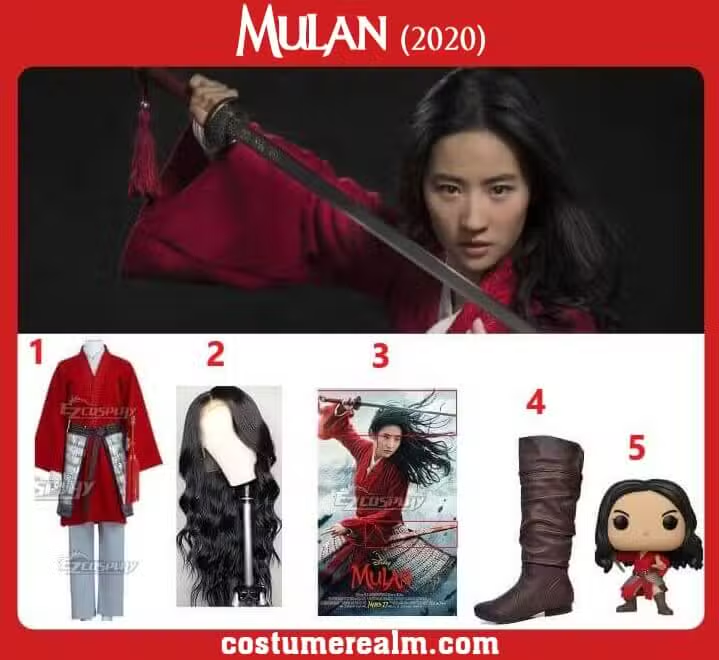
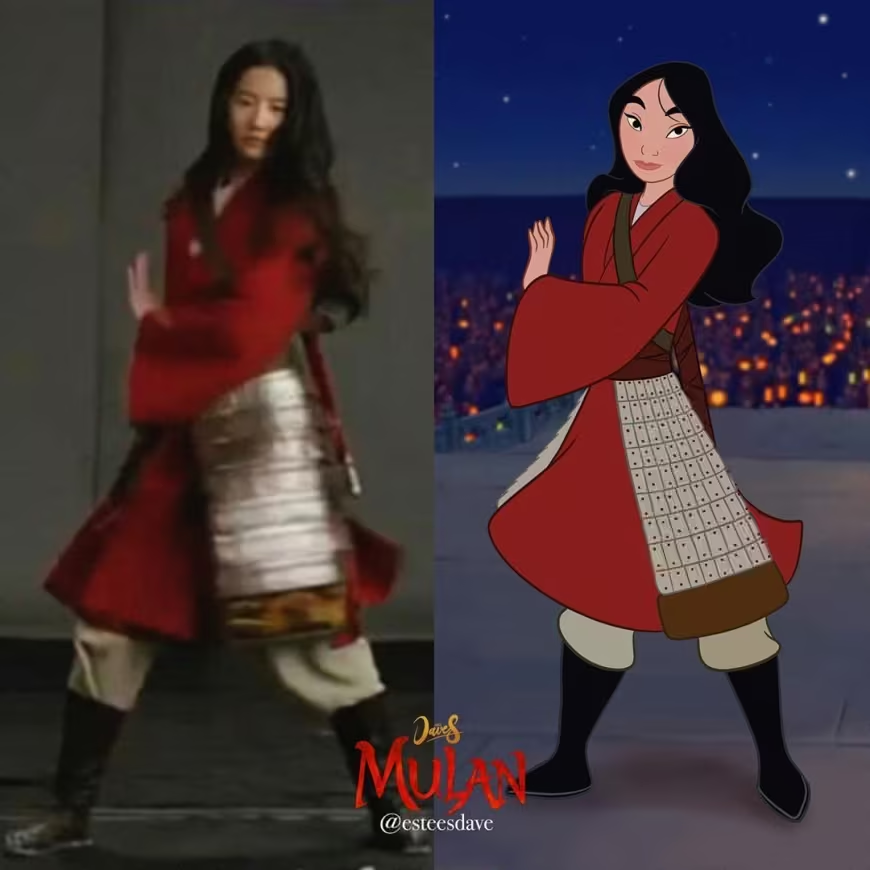
Mulan disguises herself as a male soldier named Ping to take her aging father’s place in the Imperial Army, then ends up saving all of China, which was arguably more than the job required. She is the eighth official Disney Princess and the only one in the franchise who earned the title without royal blood or a royal marriage (Wikipedia). The 1998 animated film, with Ming-Na Wen as the voice of Mulan, introduced the character to a generation that still recognizes it instantly. The 2020 live-action remake, starring Liu Yifei, gave the costume a second visual identity that skews older and more warrior than princess. For Halloween, both versions work. The choice is mostly a question of which version you know better.
Affiliate links. We may earn a small commission at no extra cost to you.
The sword is the first thing people notice, and it needs to be in your hand rather than tucked under your arm. Both versions of Mulan carry it with purpose. If it is dangling awkwardly or put down on a table somewhere, the costume reads as a hanfu with no particular context. The 2020 live-action look depends on the cosplay costume fitting properly. A costume that is a size too large collapses the warrior silhouette and turns it into a fancy dress. Order your actual size.
There is a moment in the 1998 film where Mulan, disguised as Ping, climbs a tall wooden post with training weights tied to her wrists, retrieves an arrow from the top, and slides back down in front of every soldier who wrote her off. She does not say anything. She just hands the arrow to Shang and walks away. That is the character at a party too: she does not explain herself, and she does not need to. If someone asks about the costume, “I saved China” is a complete answer.
Pink hanfu vs blue hanfu: which to pick
The pink matchmaker dress is the more iconic of the two for anyone who watched the 1998 film as a child. It is also the dress she wears before she becomes a soldier, which is worth knowing if you want the costume to read as “warrior Mulan” rather than “pre-army Mulan.” The blue infiltration dress references the palace rescue sequence and leans into the fighter identity. If you want both options available, the blue travels better at a party.
Mushu as a social prop
The Mushu plush does something most costume props do not: it starts conversations without you having to say anything. People who know the 1998 film will react to it immediately. People who do not will ask what it is, which gives you an opening. At a crowded party where the sword becomes inconvenient after an hour, Mushu fits in a bag and still does recognition work. I’d take it over the Funko Pop for a costume you are actually wearing out.
Couples Idea
Excellent couple concept with a specific dynamic to work with. Li Shang spends most of the film trying to maintain authority over a soldier he does not realize is both smarter than him and a woman, and by the end he shows up at her house pretending to return a helmet. His costume is the Imperial Army commander look: dark armor, topknot, and the general energy of someone who is very competent and occasionally very wrong. The contrast between a warrior general and a Disney Princess who outranked him by the third act is genuinely funny if both people commit to it.
Duo Idea
Strong duo if one person is willing to commit to a dragon costume. Mushu is small, loud, and absolutely convinced he is the reason Mulan succeeded, which gives the person playing him a clear character to inhabit for the evening. A red dragon costume with gold accents is the reference. The dynamic is the whole film in two people: Mulan is competent and serious, Mushu is enthusiastic and frequently a problem, and somehow together they work.
Group Idea: Imperial Army
Excellent group for a Mulan-specific crowd. The three soldiers, Yao, Ling, and Chien-Po, are visually distinct from each other (short and stocky, tall and thin, large and cheerful) and all three have specific energy that makes the group dynamic obvious without explanation. The problem is that Yao, Ling, and Chien-Po have low recognition outside of people who have actually watched the film more than once. At a general Halloween party, this reads as “Mulan and some Imperial soldiers.” At a Disney fan event, it reads exactly right.
Group Idea: Disney Warrior Women
Might work, but this group requires everyone to pick a Disney warrior who is not a traditional princess, which means committing to characters who each have their own distinct look and weapon. Merida has a bow, Raya has a staff, Moana has an oar, Mulan has a sword. The visual contrast is the point. The challenge is that all four costumes need to be built correctly for the group to read, and one person showing up in a generic princess dress instead of the right warrior look breaks the concept entirely. Convention-ready if everyone commits. Party-ready only if the group actually knows the films.
Both versions of this costume are straightforward builds. The main decision is whether you are buying a complete costume or supplementing pieces you already own.
Mulan is not a character who announces herself. Her whole arc is built around being underestimated and choosing to prove something rather than explain it.
Pick a version first. For the 2020 live-action look, start with the Mulan cosplay costume, add a black wavy wig, brown knee-high boots, and carry the toy sword. For the 1998 animated version, choose the pink or blue hanfu costume, add the necklace, kung fu shoes, and bring the Mushu plush as a prop. Both versions are recognizable. The sword is the item that ties either look together.
Yes, and it works for both kids and adults without explanation. The 1998 animated film has been a Halloween staple for nearly thirty years, and the 2020 live-action film added a second visual reference that most people recognize. Recognition is broad across age groups because the character appears in both childhood memories and recent streaming.
Three stand out. The defiant one: “My name is Mulan! I did it to save my father.” The philosophical one that sounds like it belongs on a fortune cookie but is actually good advice: “Reflect before you snack—act!” And the one she delivers after her ancestors sent backup: “Uh, my ancestors sent a little lizard to help me?” All three are from the 1998 animated film (Disney).
The 1998 animated version uses the pink matchmaker hanfu or the blue battle dress, both bright and stylized. The 2020 live-action version is darker and more grounded, built around the cosplay costume with boots and a black wig. The animated version reads more immediately as a Disney Princess. The live-action version reads more as a warrior.
It helps more than almost any other prop in this build. Both versions of Mulan are defined by her father’s sword, the inscription on it, and what she risks to carry it. Without it, the costume is a hanfu or a cosplay outfit. With it, it is Mulan.
Mulan is played by Liu Yifei in the 2020 live-action remake (IMDb). Ming-Na Wen, the speaking voice of the original 1998 animated Mulan, makes a cameo in the remake as an esteemed guest who introduces Mulan to the Emperor.
She is the eighth official Disney Princess, and the only one in the franchise who is not royalty by birth or marriage. She earned the title through military achievement and the kind of bravery the other princesses tend to reserve for act three.